

What is geothermal greenhouse heating and why does it work?
Geothermal greenhouse heating uses the earth’s stable underground temperatures to warm your growing space, significantly cutting fuel costs compared to conventional energy sources. The ground a few feet below the surface holds a surprisingly consistent temperature year-round, roughly 50°F at 5–6 feet deep, regardless of what the air above is doing. That stored thermal energy is the foundation of every geothermal system, from simple earth tubes to full heat pump installations.
For gardeners and educators running hobby or school greenhouses, the appeal is straightforward: stable root-zone temperatures, lower heating bills, and less dependence on propane or electric resistance heat. Soil thermal mass and underground heat storage act as natural climate regulators, smoothing out the temperature swings that stress plants overnight.
Key benefits at a glance:
- Dramatically reduced fuel costs compared to conventional heating
- Stable day-to-night temperatures that support consistent plant growth
- Works year-round for both heating and cooling
- Scalable from a small backyard structure to a large school greenhouse
- Compatible with passive solar design and other renewable energy sources
- Low maintenance once properly installed
Table of Contents
- Heat pumps vs. climate batteries: what’s the real difference?
- What you need to know before installing a geothermal system
- How passive solar design and supplemental heating work together
- Practical tips for gardeners and educators running geothermal systems
- How geothermal heating affects plant growth and yield
- Combining geothermal with other renewable energy sources
- Key Takeaways
Heat pumps vs. climate batteries: what’s the real difference?
This is where most gardeners get confused, and the distinction genuinely matters before you spend a dollar on equipment.
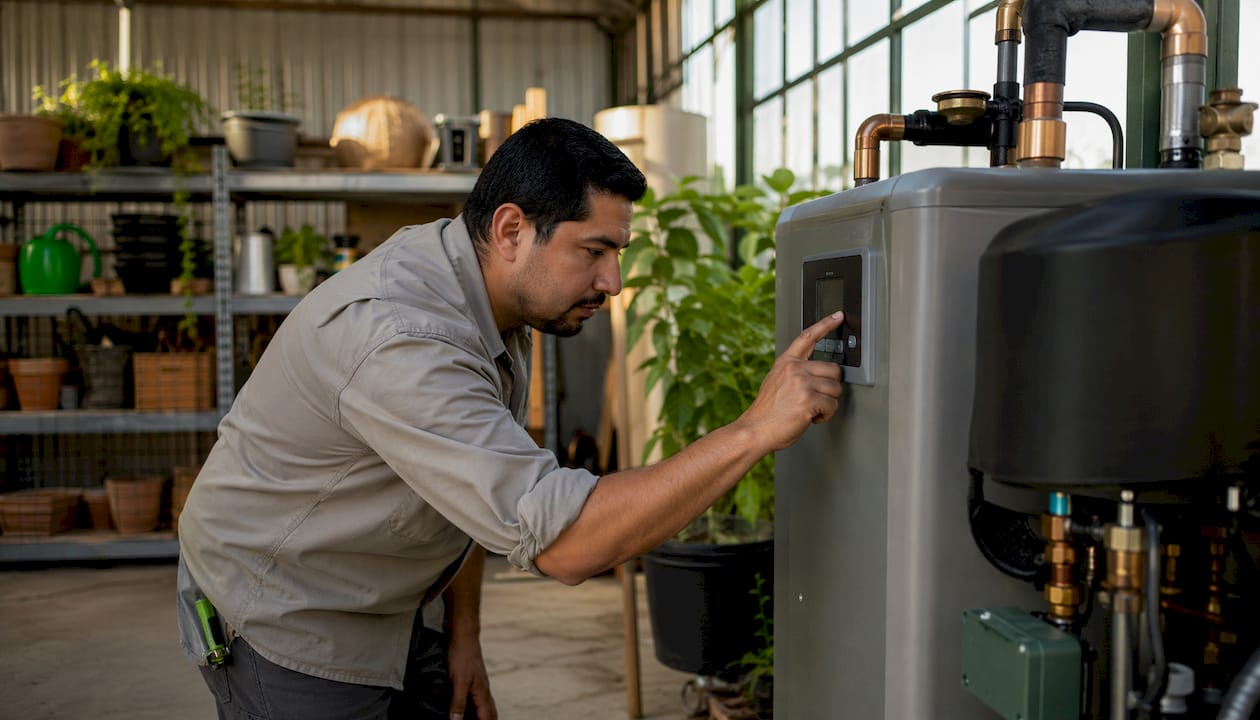
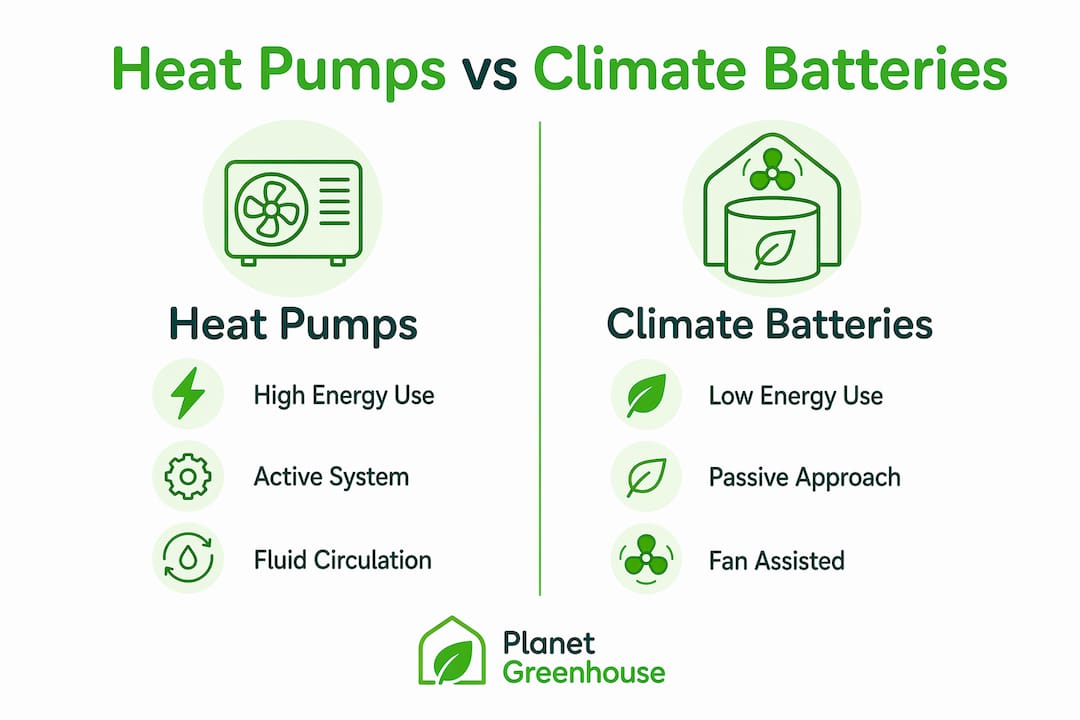
A geothermal heat pump is an active system. It circulates a fluid underground through closed or open loops, then runs that fluid through a refrigeration cycle to amplify the extracted heat to usable temperatures. Heat pumps and climate batteries are fundamentally different technologies: heat pumps are more complex, more expensive, and necessary when you need to push greenhouse temperatures well above what the ground naturally provides.
A climate battery (also called a Ground to Air Heat Transfer system, or GAHT) is a passive or low-energy approach. Fans push warm daytime greenhouse air through underground tubes buried 3–4 feet deep, charging the subsoil with heat. At night, the same system draws that stored warmth back into the growing space. The energy cost is minimal: essentially just the fans.
Side-by-side comparison:
| Feature | Geothermal heat pump | Climate battery |
|---|---|---|
| Energy use | High (refrigeration cycle) | Low (fans only) |
| Installation cost | High | Moderate |
| Temperature output | High (65°F+ possible) | Moderate (near soil temp) |
| Complexity | Complex, professional install | DIY-friendly |
| Best for | Year-round warm crops | Frost protection, season extension |
Pro Tip: If your goal is keeping a hobby greenhouse above freezing through a New England winter, a climate battery paired with good insulation often gets you there without a heat pump. Save the heat pump conversation for when you’re growing tropicals or high-value crops that need 65°F+ nights.
What you need to know before installing a geothermal system
Installation decisions made early save expensive corrections later. Here is what actually matters:
- Soil assessment first. Heavier soils store more heat and allow tighter tube spacing. Sandy soils need wider spacing. Clay content above a certain threshold can cause condensation to form a shell around underground tubing, eventually clogging the system.
- Radon testing is non-negotiable. Before burying any air-circulation tubing, test your soil for radon. This is a standard recommendation from agricultural extension services and takes only a few days.
- Depth determines performance. For climate batteries in USDA zones 4–5, tubing buried at 3–4 feet hits the performance sweet spot. Going significantly deeper adds cost without proportional benefit. All tubing should sit at least 12 inches below the soil surface to avoid accidental puncture during planting or bed preparation.
- System type options: Closed-loop systems circulate antifreeze through buried pipes and work well where land is available for horizontal runs up to 400 feet. Vertical loops suit sites with limited footprint, using boreholes from 75–500 feet deep. Open-loop systems draw directly from groundwater and can be economical when a well or pond is nearby. Earth tubes are the simplest option, drawing air through corrugated plastic pipe buried 6–12 feet down.
- Payback period. Most geothermal systems pay back their installation cost within a reasonable timeframe at current energy prices, sometimes faster depending on the system and local fuel costs.
- Energy conservation before installation. Reduce air infiltration, add insulation to sidewalls and the foundation perimeter, and install energy curtains before sizing any geothermal system. These steps shrink the heating load and reduce the system size you actually need.
How passive solar design and supplemental heating work together
Passive solar design should come before any geothermal investment. A greenhouse that leaks heat through poor glazing or a drafty foundation will defeat even a well-designed underground system.
The fundamentals: orient your greenhouse to maximize south-facing glazing, choose materials with good insulating value (twin-wall polycarbonate outperforms single-pane glass for heat retention), and place thermal mass on the north wall where it absorbs daytime heat and radiates it overnight. Water is the most efficient thermal mass material available. A wall of 55-gallon barrels costs very little and holds more heat per cubic foot than concrete or stone. Checking out greenhouse glazing options before you build or retrofit pays off in lower heating loads for years.
Even a well-designed geothermal system needs backup on the coldest nights. That’s where supplemental heaters earn their place:
- The Palram Canopia 1500W Carbon Fiber Infrared Heater delivers targeted radiant heat directly to plants without warming dead airspace first. It’s a clean, efficient option for spot heating during cold snaps.
- A portable electric greenhouse heater gives you flexible backup coverage when geothermal output alone falls short during extended cold stretches.
- The Mont Solar Powered Ventilation System handles air circulation without drawing from the grid, supporting the temperature stability that geothermal systems create.
Best design practices:
- South-facing orientation with maximum glazing exposure
- Twin-wall polycarbonate or insulated glazing on north and side walls
- Water barrels or masonry thermal mass on the north interior wall
- Perimeter foundation insulation to prevent ground-level heat loss
- Energy curtain drawn at night to cut the heated volume in half
- Exhaust fan for summer cooling (a lexan panel simplifies installation)
Pro Tip: Before adding any heater, draw an energy curtain across the interior on cold nights. Halving the heated volume is free and often more effective than adding another kilowatt of heat.
Practical tips for gardeners and educators running geothermal systems
Getting the most from a geothermal setup comes down to consistent monitoring and a few smart habits. For winter greenhouse management, these practices make a measurable difference:
- Monitor both soil and air temperatures at multiple points. A single thermometer near the door tells you almost nothing about root-zone conditions across the growing beds.
- Check tubing and fans seasonally. Climate battery fans are low-maintenance, but debris, condensation buildup, and thermostat drift can quietly reduce system output over a winter.
- Match crops to your system’s output. Perennials, herbs, and cold-tolerant vegetables can often run on direct geothermal heat with no pump. Warm-season crops like tomatoes or cucumbers typically need supplemental heat during the coldest months.
- Layer your climate control. Geothermal handles the baseline. Thermal mass handles overnight swings. Supplemental heaters cover extreme events. No single system needs to do everything.
-
Dos and don’ts:
- Do insulate the foundation perimeter before commissioning any underground system
- Do test for radon before burying air-circulation tubing
- Don’t skip the energy curtain on nights below 20°F
- Don’t oversize your supplemental heater and undersize your insulation
- Do keep a seasonal log of soil and air temps to catch efficiency drops early
Not sure which system fits your greenhouse size, climate zone, or crop plan? The team at Planetgreenhouse is happy to talk through your specific situation. Most of the best decisions happen in a conversation, not a checkout cart.
How geothermal heating affects plant growth and yield
Temperature stability is the variable most growers underestimate. Plants don’t just respond to average temperature; they respond to swings. A greenhouse that drops 25°F overnight stresses roots, slows nutrient uptake, and invites disease. Geothermal systems, by maintaining consistent soil and air temperatures, remove that stress almost entirely.
The yield data from hybrid systems is striking. A strawberry greenhouse study combining photovoltaic-thermal panels with a geothermal heat pump achieved a 4% yield increase alongside 78% heating cost savings compared to a kerosene boiler. The yield gain came directly from greater temperature stability, not from any change in light or nutrition. For educators running school greenhouses, that kind of measurable outcome makes geothermal heating a compelling teaching tool as well as a practical one.
Root-zone heating, delivered through in-floor tubing or warm-water distribution, also accelerates germination and extends the productive season at both ends of the calendar.
Combining geothermal with other renewable energy sources
Geothermal heating works well on its own, but it works better when paired with solar. The hybrid photovoltaic-thermal (PVT) approach is the most studied combination. In the strawberry greenhouse research cited above, PVT panels installed over just 10% of the greenhouse area stored excess solar heat in an aquifer during summer, then released it to support the geothermal system through winter. The result was an annual system coefficient of performance (COP) of 3.38, with solar electricity offsetting 36.72% of the heat pump’s power consumption.
For hobby and school greenhouses, the practical takeaway is simpler: a solar-powered ventilation system like the Mont Solar Powered Ventilation System reduces grid dependence while keeping air moving through the geothermal circuit. Even a modest solar array can power the fans that drive a climate battery, making the entire heating system effectively free to operate on sunny days. Pairing renewable electricity with underground thermal storage is the direction the whole industry is moving, and it’s already accessible at the hobby scale.
Key Takeaways
Geothermal greenhouse heating uses stable underground temperatures to cut fuel costs dramatically while maintaining the temperature consistency that plants need to thrive.
| Point | Details |
|---|---|
| Fuel cost savings | Agricultural extension data shows geothermal systems can save up to 80% on fuel costs versus conventional heating. |
| System type matters | Climate batteries suit frost protection and season extension; heat pumps are needed for warm-crop temperatures above what the ground provides. |
| Tubing depth is critical | Bury heat exchange tubing at 3–4 feet for optimal performance; keep all tubing at least 12 inches below the soil surface. |
| Passive solar comes first | Address glazing, insulation, and thermal mass before installing any geothermal system to reduce heating load and system size. |
| Hybrid renewables boost yield | A PVT and geothermal heat pump combination achieved a 4% yield increase and 78% heating cost savings in a strawberry greenhouse study. |