

What are the best greenhouse drip irrigation suppliers in the US?
Greenhouse drip irrigation delivers water directly to the root zone, significantly reducing water consumption compared to overhead watering while keeping foliage dry and disease risk low. Three US suppliers stand out for 2026: DripWorks for customized kit design, Drip Depot for broad inventory at competitive prices, and NutraDrip Irrigation Systems for commercial subsurface installations.
| Supplier | Kit Types | Service and Customization | Shipping | Specialization | Best For | Rating |
|---|---|---|---|---|---|---|
| DripWorks | Garden bed, drip tape, deck, cannabis, individual plant kits | Personalized irrigation plan design | Not publicly listed | Above-ground drip | Passionate gardeners and greenhouse professionals needing custom plans | 4.4★ (456 reviews) |
| Drip Depot | Greenhouse, indoor, farming, gravity, solar, landscape kits | Broad parts catalog, DIY-friendly | Free shipping from $49 | Above-ground drip | Hobbyists and growers wanting wide selection at low cost | 4.4★ (164 reviews) |
| NutraDrip Irrigation Systems | Custom subsurface drip systems | Design, installation, farm visits, soil and water sampling | Not publicly listed | Subsurface drip | Commercial growers focused on water and nutrient efficiency | 5★ (5 reviews) |
DripWorks, based in Willits, CA, goes beyond selling parts. Their personalized design service means a greenhouse grower can submit their layout and receive a mapped irrigation plan rather than guessing at emitter spacing. That service is genuinely useful for anyone running mixed crops or irregular bench configurations.
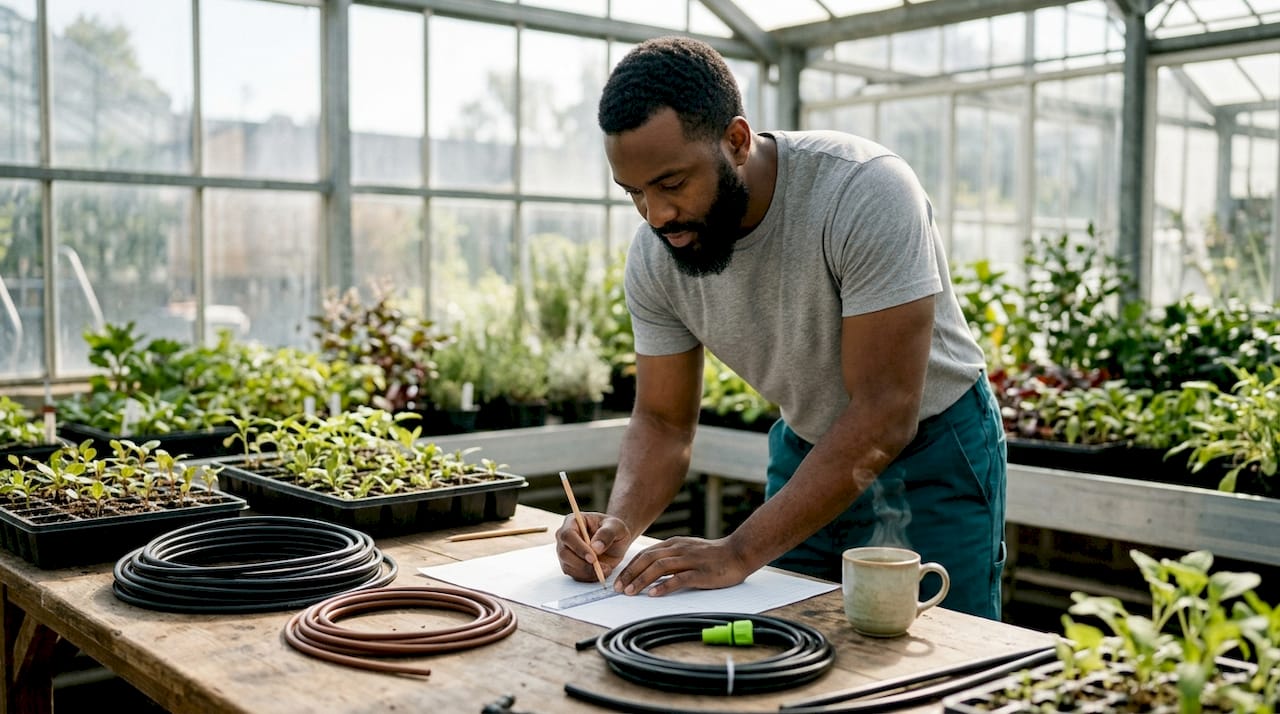
Drip Depot is the go-to for growers who know what they need and want it fast. Their greenhouse-specific kit category covers everything from button drippers and dripper stakes to hanging drippers and multi-outlet assemblies. Free shipping kicks in at $49, which covers most starter kits.
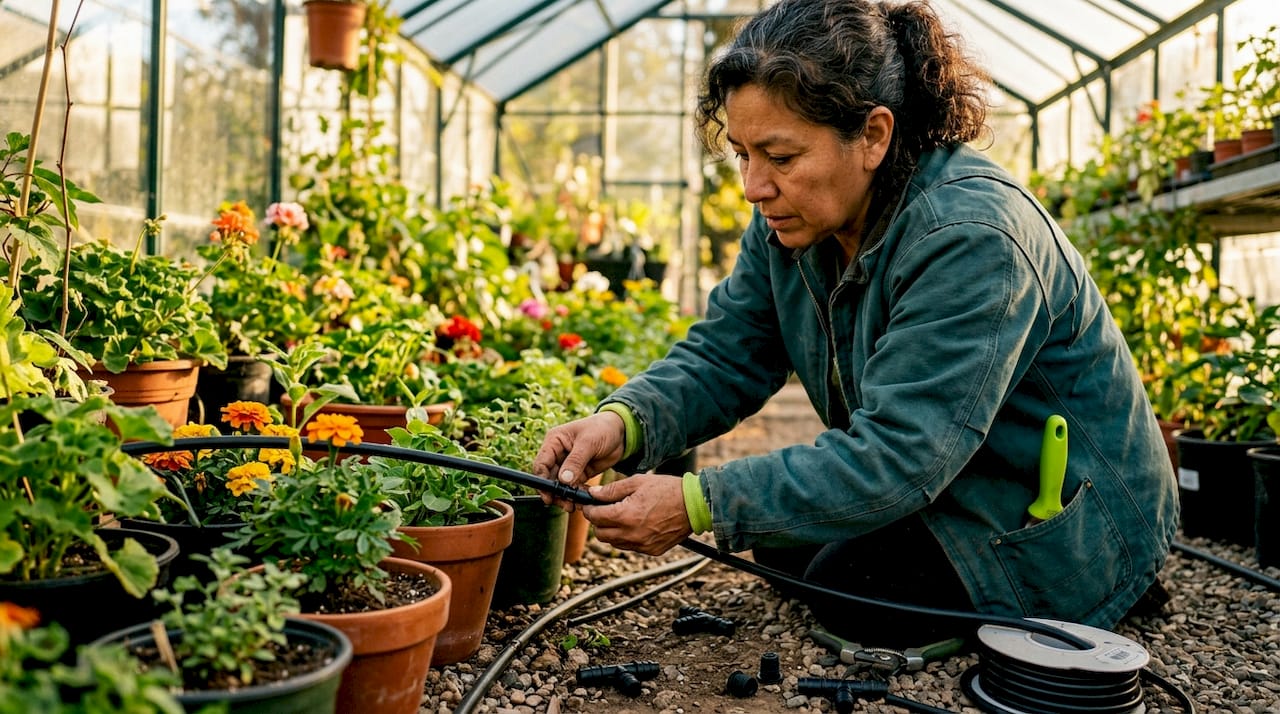
NutraDrip operates in a different tier entirely. Their subsurface drip systems are custom-engineered per farm, with consultation, soil sampling, and on-site visits included. This is not a kit-in-a-box operation. It suits commercial vegetable growers who want to manage water and fertilizer inputs with precision at scale.
How do you choose the right greenhouse irrigation system?
The right system depends on four things: your greenhouse size, crop variety, how often your layout changes, and whether you want to automate.
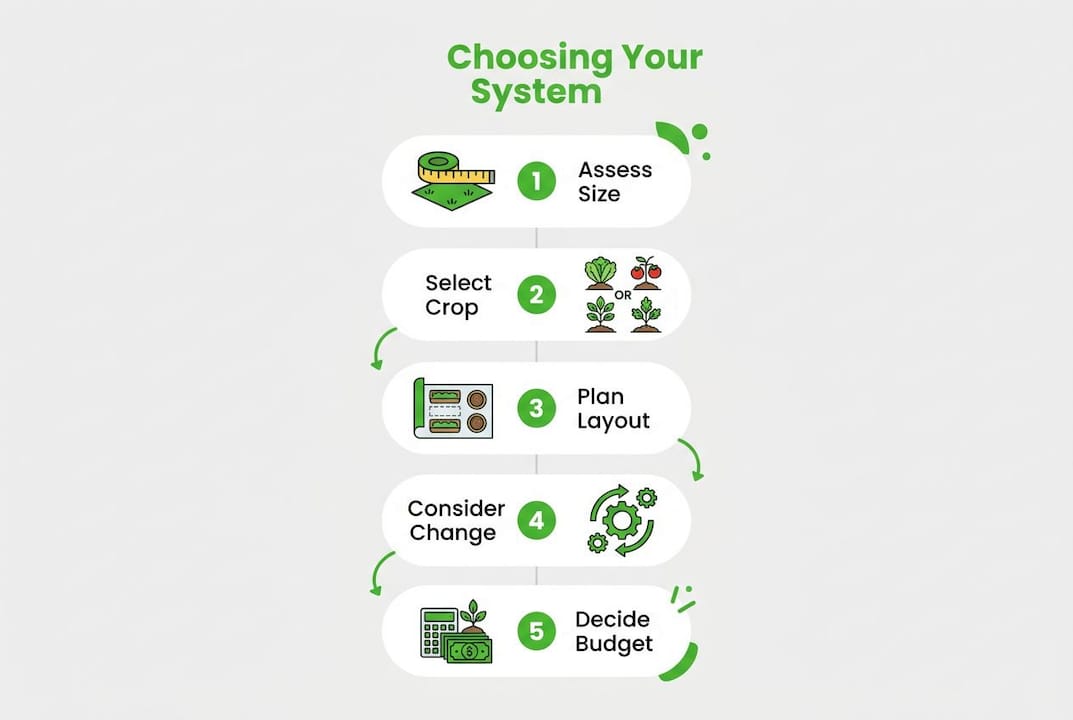
Modular systems using external button drippers and microtubing handle dynamic plant spacing far better than fixed drip tape. If you rotate crops seasonally or move benches around, a modular setup lets you reconfigure emitter positions without replumbing the whole line.
Key criteria to evaluate before buying:
- Emitter type: Button drippers suit potted crops; drip tape works for ground beds and grow bags.
- Pressure compensation: Pressure-compensated drippers maintain uniform flow regardless of elevation, which matters for hanging baskets or sloped greenhouse floors.
- Automation: Timer-based or sensor-driven controllers reduce labor and prevent over or under-watering between visits.
- System scale: Small growers often do well with all-in-one kits; commercial operations typically need custom manifold systems for consistent uniformity across many zones.
- Crop compatibility: Tomatoes, cucumbers, and peppers in grow bags need individual drippers; bedding plants in trays may suit drip tape or boom irrigation instead.
Pro Tip: Buy a modular system even if your current layout is simple. Greenhouses evolve faster than most growers expect, and a system you can reconfigure in an afternoon is worth far more than one you have to rebuild from scratch.
How to install and maintain a greenhouse drip irrigation system
Installation basics
Start with a layout sketch before ordering anything. Map your benches, beds, or containers, then calculate the total run length and number of emitters per zone. Keep each zone on a single pressure circuit to avoid flow imbalance.
Place emitters 2–3 inches from the container edge, slightly off-center. This encourages roots to grow outward into the full substrate volume rather than concentrating moisture in one spot. For seedlings and cuttings, angle drip stakes toward the plant center to support early root establishment.
Connect your main supply line first, then run lateral tubing to each bench or row. Flush all lines before attaching emitters to clear debris from manufacturing and shipping. Pressure-test the full system at operating pressure before planting.
Maintenance schedule
Regular inspection prevents the two most common failures: mineral buildup that reduces emitter output and kinked lines that cut flow to entire zones. Both problems are invisible until a plant shows stress.
Maintenance best practices:
- Inspect emitters and connections weekly during peak growing season.
- Flush lateral lines monthly to clear sediment and salt deposits.
- Check filters every two weeks; replace or clean when flow drops noticeably.
- Replace worn or clogged emitters rather than cleaning them repeatedly.
- Adjust emitter positions as plants grow and canopies expand.
Pro Tip: Run a quick uniformity check every month: place identical containers under several emitters, run the system for a set time, and compare collected volumes. A variance of more than 10% signals a clog or pressure problem worth fixing before it affects your crop.
Why drip irrigation works so well in greenhouses
Drip irrigation notably reduces water use versus overhead watering in greenhouse settings, and that figure understates the full benefit. Keeping foliage dry cuts fungal disease pressure significantly, which reduces the need for preventive fungicide applications.
Water savings in focus: Connecting drip systems to tensiometer-based controllers can reduce runoff to nearly zero in potted crops, protecting groundwater and cutting fertilizer loss at the same time.
Precise water delivery also enables what commercial growers call plant steering: by controlling exactly how much water and nutrient solution each plant receives at each growth stage, you can push crops toward vegetative or generative growth on demand. This level of control is simply not possible with overhead sprinklers or hand watering.
Monitoring substrate moisture with sensors or by lifting containers regularly keeps irrigation schedules calibrated to actual plant demand rather than a fixed clock. Drip irrigation rewards active management. A “set it and forget it” approach wastes the system’s biggest advantage.
How long do drip irrigation hoses last, and how do you extend their life?
Drip tubing in a greenhouse typically lasts several growing seasons when maintained properly, but UV exposure, mineral deposits, and physical damage from foot traffic or wildlife shorten that lifespan fast.
Black polyethylene tubing holds up better than clear tubing under greenhouse light conditions. Flush lines at the start and end of each season to clear salt buildup before it hardens inside emitters. Store any removable tubing indoors during winter if your greenhouse goes unheated, since freeze-thaw cycles crack fittings and split lateral lines.
Mineral buildup is the slow killer. It reduces emitter flow gradually, so the damage is easy to miss until one zone is visibly underwatered. A dilute acid flush (following the manufacturer’s guidance for your emitter type) once or twice per season keeps flow rates consistent. Replace any emitter that does not recover after cleaning.
What does a greenhouse drip irrigation system cost?
Entry-level kits from Drip Depot start at $49 with free US shipping, covering a small bench or a handful of containers. Mid-range modular setups for a hobby greenhouse typically run into the low hundreds of dollars once you add a timer, filter, pressure regulator, and enough tubing for your layout.
DripWorks does not publish a flat price list because their personalized design service produces custom quotes based on your specific greenhouse dimensions and crop mix. Expect to pay more than a standard kit, but you get a mapped plan rather than a bag of parts.
NutraDrip’s subsurface systems are priced for commercial operations. Costs vary by acreage, soil type, and system complexity. Their consultation and farm visit services are included in the project scope rather than sold separately.
Budget planning tip: factor in the filter, pressure regulator, backflow preventer, and timer as non-optional components. Skipping any of them to save money upfront usually results in a more expensive repair or replacement within the first season.
How long does it take to set up a drip irrigation system in a greenhouse?
A small hobby greenhouse with one or two bench zones takes most growers a half-day to set up from scratch, including layout planning, tubing cuts, and emitter placement. A 20-foot greenhouse with three or four zones typically runs four to six hours for someone doing it for the first time.
Ordering pre-punched poly pipe with drippers already inserted cuts installation time significantly. The labor of punching hundreds of holes at precise spacing and pressing in each dripper is the most time-consuming part of any larger installation.
Commercial greenhouse setups with multiple manifold zones, automated controllers, and subsurface lines require professional installation. NutraDrip’s process, for example, includes site visits and custom system design before any pipe goes in the ground, so the timeline extends to weeks rather than hours.
Planetgreenhouse has the greenhouse structure your drip system needs
Getting the irrigation right starts with getting the greenhouse right. Planetgreenhouse carries greenhouse kits sized for every scale, from compact hobby structures to larger growing spaces built for serious production, and every one of them is designed to support a full automatic watering system from day one.
The Mont Automatic Greenhouse Watering Systems are available in 8FT, 12FT, 16FT, 20FT, and 24FT configurations, so you can match the watering system length to your exact bench layout without cutting corners. Pair one with a Solexx Conservatory Greenhouse and you have a structure built for year-round growing with a watering system already sized for it. Planetgreenhouse also offers financing options, so the upfront cost of a quality setup does not have to stop you from starting.
Key Takeaways
For greenhouse growers in the US, drip irrigation paired with sensor-based control delivers the best combination of water efficiency, disease reduction, and crop consistency available in 2026.
| Point | Details |
|---|---|
| Water efficiency | Drip irrigation cuts greenhouse water use by 40–60% versus overhead watering. |
| Runoff control | Tensiometer-controlled drip systems can reduce runoff from potted crops to nearly zero. |
| Emitter placement | Position emitters 2–3 inches from the container edge, slightly off-center, for even root zone coverage. |
| Supplier fit | DripWorks suits custom plans, Drip Depot suits budget-conscious hobbyists, and NutraDrip suits commercial subsurface installations. |
| Planetgreenhouse | Offers greenhouse kits and Mont Automatic Watering Systems in multiple lengths, sized to match your drip irrigation layout. |
Recommended
- A Guide To Water System For Greenhouse – Planet Greenhouse
- Should You Install A Greenhouse Watering System For Your Garden? – Planet Greenhouse
- Mont Automatic Greenhouse Watering System - 24FT Mont-24-WS – Planet Greenhouse
- Mont Automatic Greenhouse Watering System - 16FT Mont-16-WS – Planet Greenhouse